
Dr. A. P. J. Abdul Kalam
Scientist, Teacher, 11th President of India, and the "Missile Man"
Avul Pakir Jainulabdeen Abdul Kalam was born on 15 October 1931 in Rameswaram, Tamil Nadu. Despite his humble beginnings, he made unprecedented contributions to science and technology through sheer determination and boundless curiosity. He is regarded as the architect of India's indigenous missile program and space technology. As President, his simplicity, accessibility, and dedication to youth earned him the title "People's President." He was a brilliant scientist, an able administrator, and a teacher who inspired the youth until his very last breath.[1]
📖 Early Life and Education
Dr. A. P. J. Abdul Kalam was raised in a modest family in Rameswaram. His father, Jainulabdeen, was a boat owner and the imam of the local mosque, while his mother, Ashiamma, was a homemaker. Due to the family's weak financial condition, he sold newspapers in his childhood to support his education. During his school years, he was an average student but had a deep interest in mathematics and science. He graduated in Physics from St. Joseph's College, Tiruchirappalli in 1954, and then studied Aerospace Engineering at the Madras Institute of Technology (MIT) in 1955. According to an interesting anecdote, at MIT, he was given only three days to complete a project, which he successfully finished to save his scholarship. He dreamed of becoming a fighter pilot but could not be selected for the Air Force, as he stood ninth while only eight positions were available.
🚀 Scientific Career and Missile Program
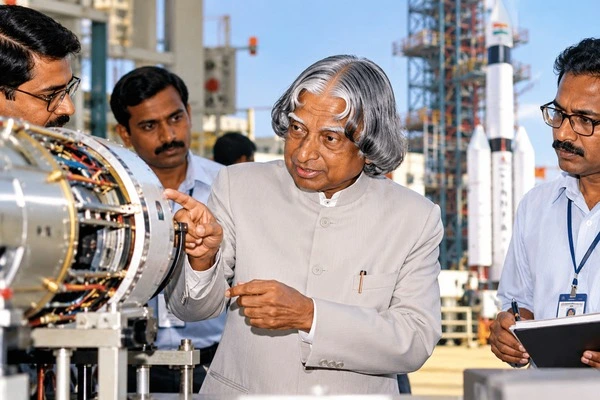
Dr. Kalam during his scientific career
After graduating in 1960, Dr. Kalam joined DRDO (Defence Research and Development Organisation). In 1969, he moved to ISRO (Indian Space Research Organisation), where he served as the project director of SLV-III, India's first indigenous satellite launch vehicle. In July 1980, SLV-III successfully placed the Rohini satellite in orbit, making India the sixth member of the space club.[2] He also played a key role in the development of the Polar Satellite Launch Vehicle (PSLV). Returning to DRDO in 1982, he planned the Integrated Guided Missile Development Programme (IGMDP) and developed successful missiles such as Agni and Prithvi.[3] This contribution earned him the title "Missile Man of India."
From 1992 to 1999, he served as the Scientific Adviser to the Defence Minister and Secretary of DRDO. During this period, he led the Pokhran-II nuclear tests in 1998, which made India a nuclear-armed nation.[4] He later served as the Principal Scientific Adviser to the Government of India from 1999 to 2001.
🇮🇳 Presidency: The People's President
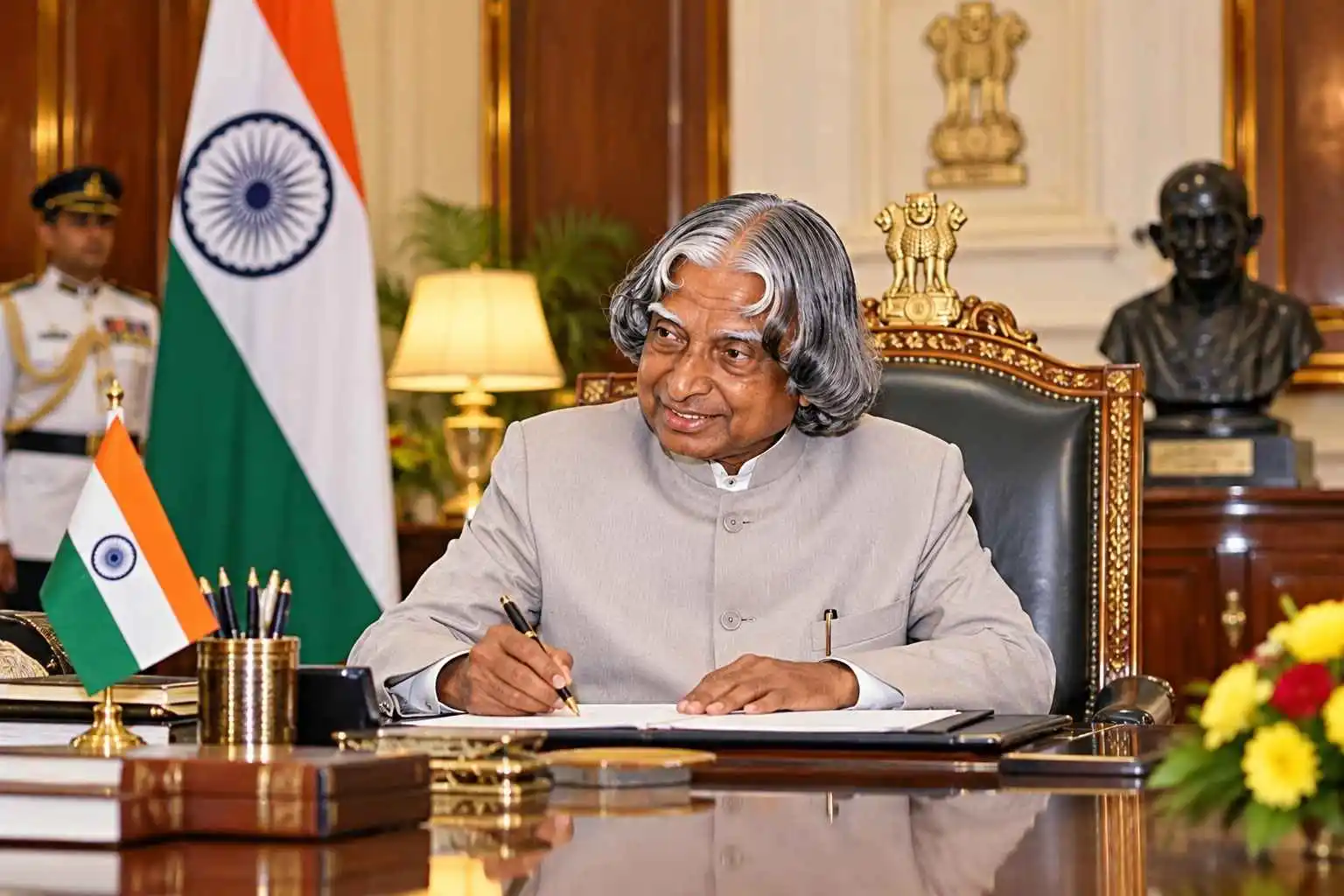
Dr. Kalam at Rashtrapati Bhavan
In 2002, Dr. Kalam was elected as the 11th President of India and served until 2007.[5] During his tenure, he opened the doors of Rashtrapati Bhavan to the general public and became popular as the "People's President." Through "Vision 2020," he set the goal of making India a developed nation by 2020 and toured schools and colleges across the country to connect directly with the youth. Even after retiring from the presidency, he continued teaching, writing, and inspiring the youth. He passed away on 27 July 2015 while delivering a lecture at IIM Shillong (Meghalaya). He breathed his last as a teacher, a testament to his dedication to life.
💡 Lesser-Known Facts
- Veena Player and Poet: Dr. Kalam loved playing the veena and writing Tamil poetry. He listened to Carnatic music daily and wrote 22 poems and 4 songs.
- Symbol of Secularism: Born in a Muslim family, Kalam had deep knowledge of Hindu scriptures too. He regularly read both the Quran and the Gita and learned Sanskrit.
- Renunciation of Wealth: After becoming President, he donated his entire salary and savings to a charitable trust (PURA). He believed the government would take care of him, so he did not need money.
- Simple Living: He never owned a television. His total possessions included about 2,500 books, a watch, some clothes, and a veena.
💬 Famous Quotes by Dr. Kalam
📚 Legacy and Inspiration
Dr. Kalam's legacy extends far beyond his scientific contributions. He wrote books such as "Wings of Fire," "Ignited Minds," and "India 2020," which continue to inspire millions of youth even today. He received honorary doctorates from more than 40 universities in India and abroad.[6] His life is proof that with true dedication and commitment, any goal can be achieved.
Internationally, Dr. Kalam was honoured with the King Charles II Medal (2007) by the Royal Society, the Hoover Medal (2009), and the Von Karman Wings Award (2013). His vision for India's development, his advocacy for renewable energy and rural development, and his belief in the power of young minds continue to shape policy and inspire generations across the globe.
🎥 Video: Life of Dr. Kalam
📖 Famous Books by Dr. Kalam
- Wings of Fire: An Autobiography
- Ignited Minds: Unleashing the Power Within India
- India 2020: A Vision for the New Millennium
- My Journey: Transforming Dreams into Actions
- Turning Points: A Journey Through Challenges
- Forge Your Future
- Transcendence: My Spiritual Experiences with Pramukh Swamiji
🔗 References
- Encyclopaedia Britannica – A.P.J. Abdul Kalam
- The Hindu – "Space story that began 25 years ago"
- President of India – Profile
- PMIndia – Cabinet Condolence
- Britannica – Presidency (2002–2007)
- President of India – Honorary Doctorates
Last updated: October 2025 | Sources: Britannica, Government of India official portals, ISRO, DRDO, and PIB